Business Growth Creates a New Technology Challenge
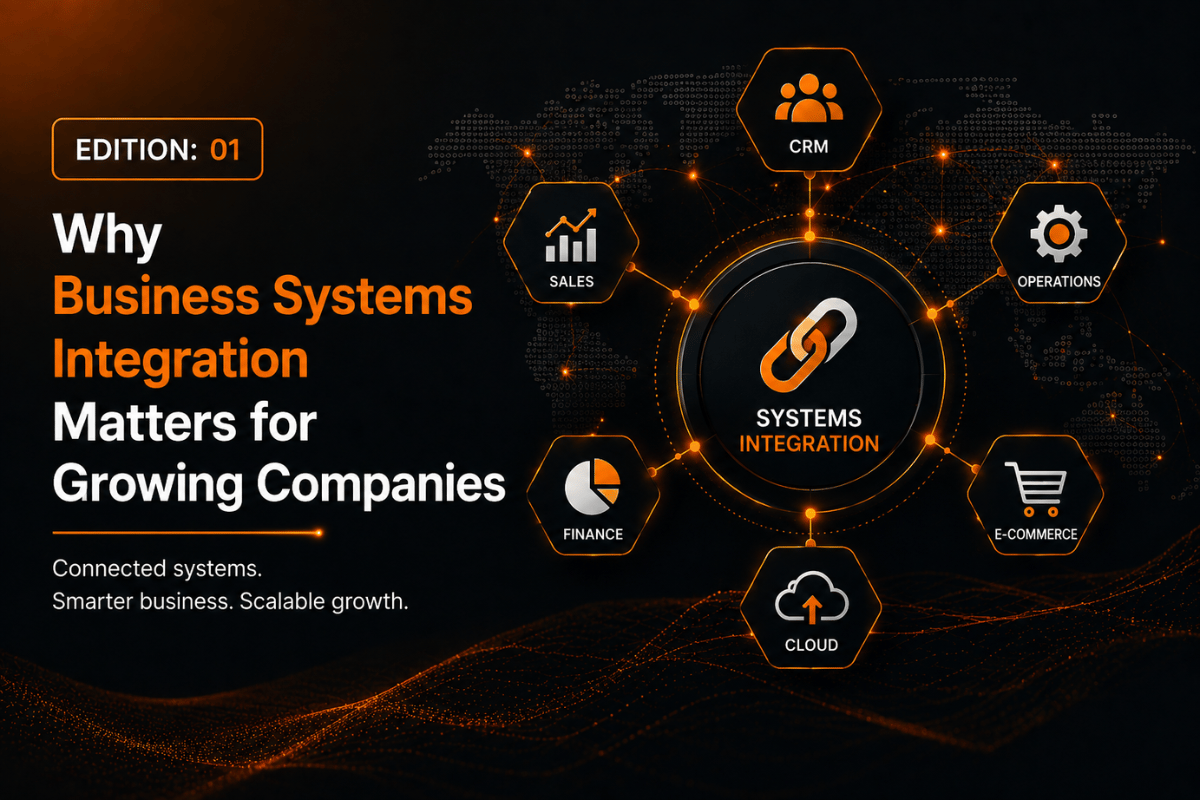
Growing a business usually means adding more customers, employees, departments, data, and technology. A company may begin with a few essential applications, but as operations expand, it often adds a CRM for sales, an ERP for operations, accounting software for finance, cloud applications for collaboration, and custom software for specific business needs.
The problem starts when these systems operate separately.
Employees may need to enter the same information into multiple platforms, move data between spreadsheets, or contact another department to obtain information that already exists somewhere else. These disconnected processes create delays, duplicate data, communication gaps, and unnecessary manual work.
This is where system integration becomes valuable.
Simply put, what is system integration? It is the process of connecting separate applications, platforms, databases, and business technologies so they can exchange information and work together. Modern integration can connect CRM, ERP, cloud applications, websites, databases, and custom software through APIs, middleware, connectors, and other technologies.
For growing companies, integration is not just an IT project. It can become an important part of improving productivity, automation, operational efficiency, and long-term business growth.
Why Growing Companies Need Integrated Systems
Small businesses can sometimes manage disconnected tools because their teams and processes are relatively simple. As a company grows, however, the amount of information moving between departments increases.
A sales team may update customer information in a CRM while finance maintains separate billing records. Operations may use an ERP, while customer service works through another platform. Marketingmay use cloud-based tools, while management depends on separate reporting software.
Without proper integration, employees become the connection between these systems.
That means people spend time downloading reports, copying information, checking records, correcting errors, and manually updating different platforms.
A connected environment changes this model. Instead of employees constantly moving information between systems, technology can handle many of these data flows automatically.
Industry sources commonly describe system integration as a way to connect ERP, CRM, e-commerce, cloud, and other business applications while reducing data silos and manual transfers.
Integration Turns Separate Applications into One Ecosystem
Having several software platforms does not automatically create an integrated business.
An integrated system means those platforms can communicate and exchange relevant information according to defined business rules.
For example:
Website → CRM → ERP → Accounting → Reporting
A customer inquiry submitted through a website could enter the CRM automatically. Once converted into an order, relevant information could move into the ERP. Financial information could then reach the accounting system, while management receives updated reporting data.
The employee does not need to repeatedly recreate the same information.
That is the practical value of integrating systems.
The Real Cost of Disconnected Software
Disconnected systems create costs that are often difficult to see on a financial statement.
Employees may lose time performing repetitive administrative work. Managers may wait for reports because information is stored across multiple platforms. Customers may experience delays because teams cannot access updated information quickly.
Data inconsistency is another major problem.
Imagine a customer changes their contact information. If the CRM, billing system, ERP, and customer support platform are not connected, different departments may continue using different versions of the same customer record.
This creates confusion and can eventually affect customer experience.
Manual Data Transfer Creates Operational Bottlenecks
Manual data transfer may appear harmless when a business is small. But as transaction volume increases, the same process can become a major bottleneck.
Consider an online order. Without integration, an employee may need to:
- Check the website order
- Enter customer information into another system.
- Update inventory.
- Notify finance.
- Update shipping information.
- Record the transaction for reporting.
With software system integration, much of this information can move automatically between connected applications.
This can reduce repetitive work while helping teams focus on customer service, decision-making, and higher-value activities.
ERP System Integration Connects Core Operations
For many growing organizations, ERP software becomes a central part of their technology environment.
An ERP can bring together areas such as finance, inventory, purchasing, human resources, operations, and reporting. But the ERP may still need to communicate with other applications.
This makes ERP system integration particularly important.
A business may need to connect its ERP with:
- CRM platforms
- E-commerce websites
- Payment systems
- Accounting applications
- Warehouse platforms
- HR software
- Customer service systems
- Custom business applications
When these systems communicate effectively, information can move across departments without constant manual intervention.
Current ERP integration approaches commonly use APIs, connectors, middleware, and cloud technologies to connect ERP platforms with CRM, e-commerce, finance, logistics, and other business applications.
ERP and CRM Integration
Sales and operations often depend on the same customer information but use different systems.
A CRM may contain leads, contacts, opportunities, and sales activity. The ERP may contain orders, invoices, inventory, and financial information.
With ERP system integration, relevant data can move between both environments.
Sales representatives can work with more complete customer information, while operations can receive order details without waiting for manual updates.
This creates a more connected customer journey and reduces the possibility of information being lost between departments.
Cloud Integration for Modern Businesses
Growing companies increasingly depend on cloud applications because they provide flexibility and allow teams to work across locations.
However, adding cloud applications can create another problem if those platforms remain isolated.
Cloud integration solutions allow organizations to connect cloud applications with other cloud platforms, on-premises software, databases, and legacy technologies.
For example, a company may need its CRM, ERP, e-commerce platform, payment system, and analytics tools to exchange information.
A cloud integration platform can provide a structured way to manage these connections.
This becomes especially important for companies operating in hybrid environments where some applications are hosted in the cloud while others remain on internal infrastructure.
Connecting Cloud and Legacy Systems
Not every business can replace its existing systems.
Older software may still contain valuable data or support important operations. Replacing it immediately can be expensive, disruptive, and unnecessary.
Legacy system integration provides another option.
Instead of completely removing an older system, businesses can connect it with modern applications through APIs, middleware, data pipelines, or custom integration solutions.
This allows organizations to modernize gradually while continuing to use systems that still provide business value.
Enterprise Application Integration
As organizations grow more complex, connecting individual applications may not be enough.
This is where enterprise application integration, commonly known as EAI, becomes relevant.
EAI is an approach for connecting different enterprise applications so information can move between them and business processes can operate more cohesively. It can involve CRM, ERP, databases, supply chain platforms, analytics tools, and other enterprise systems.
The purpose is not simply to make applications communicate.
The bigger goal is to create a connected technology environment where business information can move through processes without unnecessary manual intervention.
EAI Can Support Better Business Processes
A connected enterprise environment can help organizations coordinate activities across departments.
For example, a customer order can trigger inventory updates, financial processing, fulfillment activities, and customer notifications.
Instead of treating every department as a separate technology environment, integration connects the workflow.
This supports business process integration, where technology reflects how work actually moves through the organization.
Choosing the Right Integration Approach
There is no universal integration solution for every company.
A small business connecting two applications may only require a straightforward API. A larger enterprise with dozens of applications may need an integration strategy involving APIs, middleware, cloud platforms, monitoring, security, and governance.
The right approach depends on the number of systems, data volume, business processes, security requirements, and future growth plans.
|
Integration Type |
|
||
|
CRM + ERP |
Better data flow |
||
|
Cloud Integration |
Connected applications |
||
|
Legacy Integration |
|
||
|
Data Integration |
Better information access |
||
|
Enterprise Integration |
|
The important point is to solve the business problem first and select technology second.
Data Integration Improves Business Visibility
Integration is not only about moving information from one application to another. It is also about creating reliable access to business data.
When information is scattered across systems, decision-makers may struggle to understand what is actually happening.
Sales numbers may exist in one platform. Inventory information may be stored somewhere else. Financial data may sit in an accounting system.
Data integration can bring relevant information together so teams can work with a more consistent view.
This can support reporting, analytics, forecasting, and strategic decision-making.
Data Integration Best Practices Matter
Successful integration requires more than connecting two applications.
Businesses need to determine which system owns specific information, how data should be transferred, how errors will be handled, and who is responsible for maintaining the integration.
Security is also essential.
Sensitive customer, financial, and operational information should be protected throughout the integration process.
Monitoring is equally important. If a connection fails silently, incorrect or outdated information can spread across connected systems.
A strong integration architecture therefore considers data validation, authentication, error handling, monitoring, scalability, and maintenance.
What Is a System Integrator?
A system integrator is a technology professional or company that helps organizations connect different systems, applications, platforms, and technologies.
A system integrator can analyze an organization's existing environment, identify integration requirements, design the architecture, develop connections, test data flows, and provide ongoing support.
This can be particularly useful for growing companies that have accumulated multiple technologies but lack the internal resources to connect and manage them effectively.
When Should You Consider Integration Services?
Businesses should consider system integration services when disconnected technology is creating measurable operational problems.
Common warning signs include:
- Employees repeatedly entering the same data.
- Departments maintaining different versions of customer information.
- Reports requiring manual spreadsheet consolidation.
- ERP and CRM systems operating independently.
- Cloud applications creating isolated data.
- Customers experiencing delays because information is difficult to access.
When these problems become part of everyday operations, integration can move from being a technology improvement to a business necessity.
Integration Creates a Foundation for Business Growth
The purpose of integration is not simply to make today's software communicate.
A good integration architecture should also support tomorrow's requirements.
As businesses grow, they will add new applications, enter new markets, increase transaction volumes, and change internal processes.
A scalable integration environment makes it easier to introduce new technology without creating another isolated system.
This is why application integration solutions, cloud platforms, APIs, and modular architecture are increasingly important for businesses pursuing digital transformation.
Strategic integration can help reduce complexity while making it easier to connect new systems as business requirements evolve.
From More Software to Better Connected Software
Growth should not mean continuously adding disconnected applications.
The objective should be to create a technology ecosystem in which every important system has a clear role and can exchange information as needed.
CRM, ERP, accounting, websites, cloud platforms, databases, and custom applications can become significantly more useful when they operate as connected parts of the same business environment.
The right integration software can help organizations reduce data silos, improve workflow efficiency, and create stronger operational visibility.
More importantly, integration allows businesses to get greater value from technology they have already invested in.
Build Systems That Grow with Your Business
Business growth brings complexity, but technology should help manage that complexity rather than increase it.
Effective system development integration, ERP connectivity, cloud integration, application integration, and data integration can create a more connected foundation for growing companies.
The best integration strategy is not about connecting everything to everything. It is about connecting the right systems, moving the right information, and supporting the right business processes.
That approach can help organizations reduce manual work, improve information flow, strengthen decision-making, and prepare their technology environment for future growth.
At QTO DEV, we help businesses develop and connect digital solutions to their operational requirements, creating technology environments that support efficiency, scalability, and long-term business growth.
Ready to Connect Your Business Systems?
Stop letting disconnected software slow your growth. Build a connected technology environment that helps your teams work smarter and your business scale with confidence.