Artificial intelligence is changing the economics of software. Tasks that once required significant developer time can now be accelerated with AI-assisted tools, from generating code and tests to documenting existing systems. But faster development does not automatically mean better software.
The real advantage comes from creating technology that fits the way a business actually operates.
As AI makes development more accessible, custom software is becoming less about building something from scratch simply because it is possible. Instead, it is about creating software applications that solve specific operational problems, connect existing systems, and adapt to changing business requirements.
AI Is Making Software Development Faster
AI is becoming part of everyday software engineering. Developers can use intelligent tools to explore ideas, generate code, identify potential issues, and automate repetitive parts of the development lifecycle.
Google's 2025 DORA research reported that 90% of surveyed software-development professionals were using AI in their work.
That adoption creates an interesting shift. If more development teams have access to similar AI capabilities, simply developing software quickly becomes less of a differentiator.
The question becomes what businesses do with that speed.
Faster Code, Smarter Decisions
AI can help developers produce solutions faster, but businesses still need to determine what those solutions should accomplish.
A system may contain technically impressive features and still fail to solve the underlying business problem. Effective development therefore requires more than programming. It requires understanding processes, users, data, integrations, security, and long-term objectives.
This is where customization becomes increasingly valuable.
Why Standard Software Doesn't Always Fit?
Off-the-shelf software is designed to serve broad groups of users. That is its strength, but it can also become its limitation.
Two companies in the same industry may have completely different approval procedures, customer journeys, reporting structures, or operational requirements. A standard product may support both organizations, but neither may get an exact fit.
Employees then create workarounds.
They export information to spreadsheets, maintain separate computer programs, duplicate records, or manually move information between platforms. Over time, these small compromises can become significant operational friction.
The Hidden Cost of Workarounds
When software does not match the workflow, employees adapt their behavior around the technology.
That can result in:
· repeated data entry
· disconnected information
· manual approvals
· duplicated processes
· inconsistent reporting
· unnecessary administrative work
Customization addresses the problem from another direction: instead of changing the business to fit the software, the software can be designed around the business.
Customization Is Becoming a Business Advantage
The value of customized technology lies not simply in the fact that it looks different from standard software.
Its value comes from fit.
A customized system can reflect how an organization manages customers, processes information, coordinates employees, handles approvals, and measures performance.
That can make technology feel less like another tool and more like part of the operating model.
Build Around the Workflow
A strong custom solution starts with the process.
Before deciding what features to build, businesses should identify where delays occur, where employees repeat work, where information gets lost, and where decisions depend on incomplete data.
Those findings can guide the design of the software.
Connect the Existing Technology
Most businesses already have multiple software applications.
CRM platforms, accounting tools, websites, communication systems, analytics platforms, and cloud services may all contain valuable information. When these systems operate independently, employees often become the connection between them.
Well-planned customization can bring relevant systems together through integrations and automated workflows.
AI Makes Custom Software More Practical
AI does not eliminate the need for customized development. In many situations, it can make customization more practical.
Developers can use AI-assisted development tools to accelerate repetitive work, explore technical approaches, and support testing. This can free up more time for architecture, integration, security, and business-specific functionality.
That creates an important distinction between AI-generated software and AI-enabled custom software.
The first focuses primarily on producing code.
The second focuses on creating a solution that uses AI where it genuinely improves the product.
AI Can Become Part of the Product
Businesses can incorporate AI into applications for tasks such as document analysis, intelligent search, recommendations, forecasting, natural-language interaction, and workflow assistance.
For example, an internal information system could allow employees to ask questions about company information using natural language rather than searching through multiple databases.
The technology becomes valuable because it is connected to a specific business need.
Custom Software vs. Off-the-Shelf Software
Choosing customized technology does not mean standard products are obsolete.
For common requirements, existing software may be faster and more economical. Businesses should consider custom development when their processes, integrations, or strategic requirements cannot be handled effectively by available products.
Standard Software | Custom Software |
Predefined functionality | Business-specific functionality |
Standard workflows | Tailored workflows |
Vendor-controlled roadmap | Greater development control |
Limited flexibility | Higher flexibility |
Quick initial deployment | Designed around specific requirements |
The decision should therefore be based on business fit rather than the assumption that custom software is automatically superior.
The Economics of Customization Are Changing
The business case for customized software is also evolving.
Modern cloud infrastructure, reusable components, automation, and AI-assisted development can reduce some of the effort required to build and maintain software.
Grand View Research estimates that the global custom software development market could reach $53.5 billion in 2026, with substantial growth projected through 2033.
This does not mean every business should commission a custom platform.
It means the market is moving toward greater demand for technology designed around specific requirements.
Think Beyond the Initial Development Cost
Businesses evaluating software should consider the total cost of ownership.
A low-cost application may become expensive if employees constantly work around it. Likewise, a highly customized system can become inefficient if it contains unnecessary complexity.
The better question is:
What technology approach produces the strongest long-term business value?
What Should Businesses Customize?
Customization should focus on areas that directly affect performance.
Customer Experiences
Businesses can tailor portals, dashboards, communication flows, and customer-facing applications around their users rather than forcing customers through generic journeys.
Internal Processes
Approval workflows, document handling, employee coordination, scheduling, and repetitive administrative tasks can be designed around actual operating procedures.
Data and Reporting
A business should not have to manually combine information from several platforms simply to understand what is happening. Customized reporting can bring relevant information together and present it according to the organization's decision-making needs.
AI Workflows
AI should be applied selectively. Document processing, intelligent search, recommendations, forecasting, and automated assistance can be valuable when they address a genuine operational challenge.
Customization Does Not Mean More Complexity
There is a common misconception that better customization means adding more features.
It doesn't.
Every additional feature can introduce maintenance requirements, security considerations, testing needs, and future development costs.
The strongest software programs are not necessarily the largest. They are the ones designed around clear objectives.
A good customization strategy asks:
What should this software make easier, faster, or more reliable?
That question keeps development focused on outcomes instead of unnecessary functionality.
The Role of Developers Is Changing
AI is changing what developers spend their time doing, but it is not removing the need for developers.
Understanding architecture, databases, security, integrations, performance, and user requirements remains essential.
Modern developers increasingly work at the intersection of technology and business strategy.
AI can generate a possible implementation, but experienced software developers still need to evaluate whether the result is secure, maintainable, scalable, and appropriate for the intended environment.
This makes human judgment more important as development becomes faster.
The New Software Advantage
The AI era is creating a different kind of software competition.
In the past, businesses could gain an advantage simply by adopting digital technology before competitors. Today, software is everywhere. AI capabilities are becoming increasingly accessible. Cloud platforms and modern application software are widely available.
The differentiator is becoming more specific.
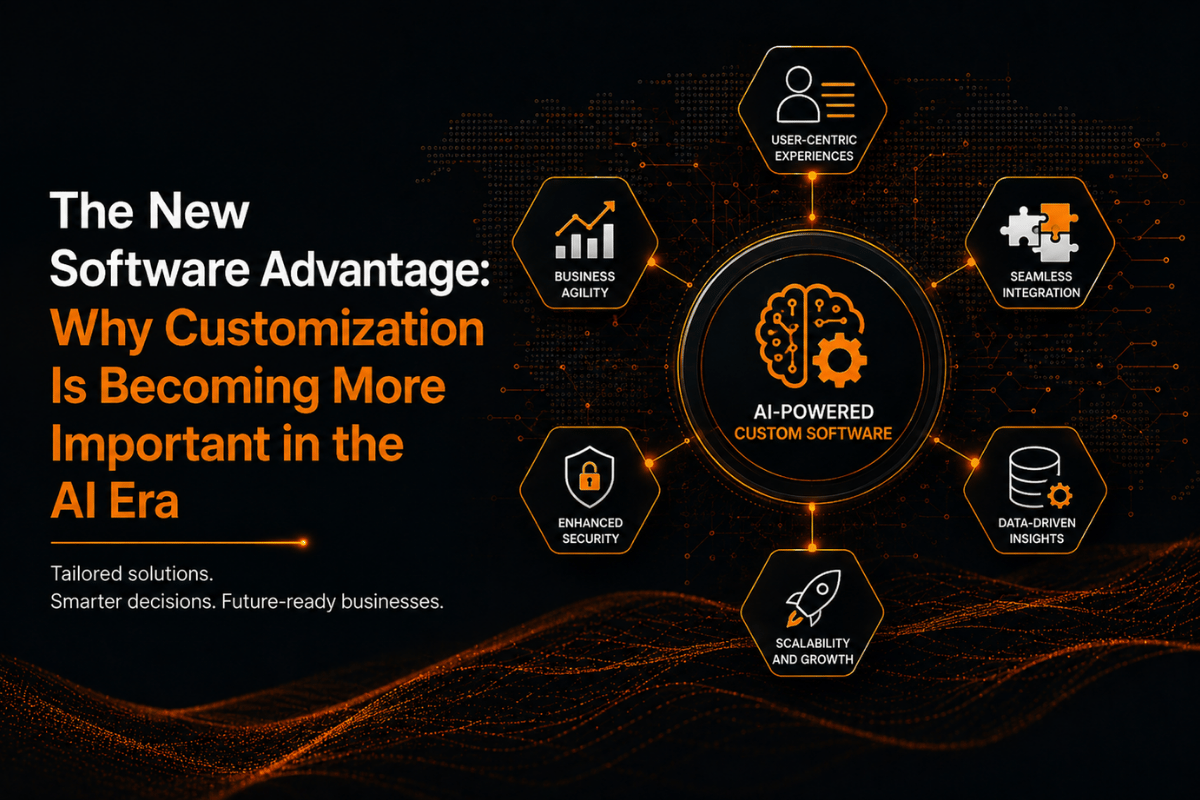
Businesses can gain an advantage by building technology that reflects their unique processes, connects their systems, uses their data intelligently, and evolves alongside their objectives.
Customization therefore should not be viewed as an alternative to AI.
It can be the framework through which AI becomes genuinely useful to a particular organization.
Conclusion
AI is making software development faster, more accessible, and increasingly intelligent. But speed alone does not create a competitive advantage.
The next advantage may come from software that is better aligned with the business using it.
Custom solutions can help organizations move beyond generic workflows, disconnected systems, repetitive tasks, and unnecessary compromises. When combined with AI, modern development tools, cloud infrastructure, and thoughtful software engineering, customization can become a practical way to create technology around real business requirements.
The future is not about building more software.
It is about building software that fits better.