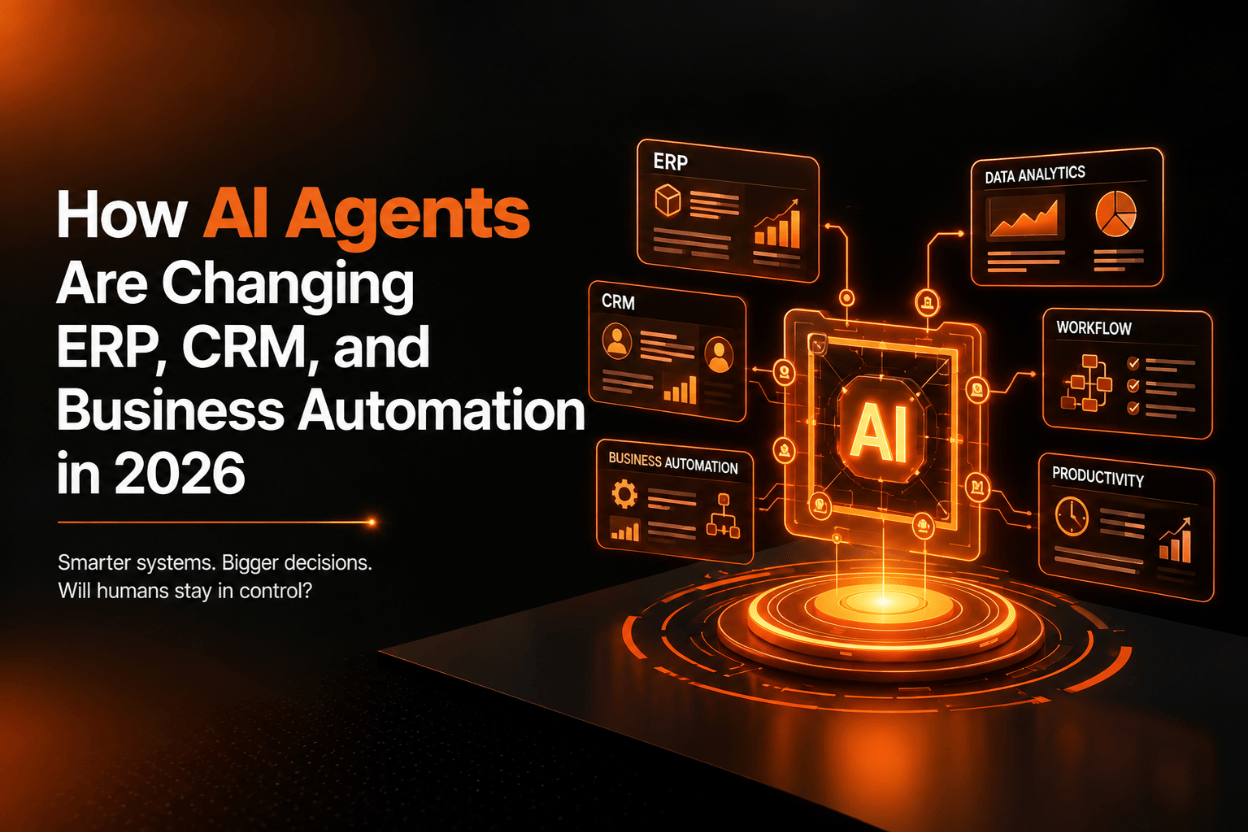
Something has shifted quietly inside enterprise software this year. For most of their history, ERP and CRM tools were glorified filing cabinets; they held onto invoices, orders, tickets, and stock counts, and waited for a person to open a screen and decide what to do next. That waiting period is disappearing. A layer of software agents now sits inside these systems, reads the same data a human would, and takes the next step on its own. That single change is behind almost every headline about "AI agents," "Agentic AI," and "AI-powered" tools that CIOs and operations leaders have been searching for this year.
A Forbes piece by Robert Kramer, published in August 2026, walked CIOs through this exact shift inside ERP. The point worth borrowing from that piece: this isn't a pilot experiment sitting in a lab anymore; it's already running inside live finance, supply chain, and customer systems. The rest of this article builds on that idea and breaks down, in plain language, what it means for ERP, CRM, and automation more broadly.
What Counts as an AI Agent?
Not every automated tool deserves the label. A chatbot waits for a question and answers it. A workflow rule follows a script someone wrote months ago and never deviates. An agent is built differently: it is given an outcome to reach, it looks at whatever data and tools are within reach, decides what order of steps gets there, and then actually performs those steps, often hopping between two or three different systems along the way.
Agent vs. Copilot: What Actually Changes
A copilot hands you a draft and waits. An agent finishes the job. Picture an invoice landing in the inbox: a copilot would summarize it for you; an agent checks it against the purchase order, catches a pricing mismatch, and sends it down the approval chain; no one has to touch five separate screens to make that happen.
What Makes 2026 Different
Two things lined up at the same time. Enterprise data finally got tidy and connected enough for software to act on it without a human double-checking every field. At the same time, the models running these agents got noticeably better at chaining several decisions together instead of answering one question in isolation. That combination is why this year, rather than last year, is when agent-based automation moved out of the sandbox.
The payoff shows up in the numbers, too. Firms that have folded AI into their ERP operations are already seeing operating-profit improvements in the mid-single digits, and companies pursuing AI aggressively as part of a growth push tend to report stronger profitability and market share than those treating it as a side project. For a CIO weighing where next year's budget goes, that's a hard number to ignore.
What Changes Inside ERP
Finance and Accounting
This is the area where agents have matured fastest. They line up invoices against purchase orders, catch a line item that doesn't add up, flag anything unusual before the books close for the month, and build cash-flow forecasts from years of history instead of a single analyst's best guess.
Supply Chain and Inventory
Agents keep a constant eye on stock levels, spot a shortage days before it becomes a problem, and can place a reorder or push back on a supplier's delivery date without anyone opening a planning spreadsheet.
HR and Procurement
New-hire paperwork, expense sign-offs, and vendor checks are increasingly handled start to finish by agents that actually understand company policy, rather than a rigid checklist that breaks the moment a request looks slightly different from the norm.
What Changes Inside CRM and Customer Experience
CRM tools are going through a parallel change. A sales rep used to spend part of every call afterward typing notes and moving a deal to the next stage by hand. Now an agent listens in, updates the record itself, drafts the follow-up note, and suggests what to do next based on everything it knows about that customer.
This is the engine behind the growing push around AI customer experience: agents closing out support tickets on their own, tailoring outreach at a volume no team of people could match, and stepping back only when a situation genuinely calls for a human's judgment. Retail companies, in particular, are pairing live inventory data with what they know about a shopper, so nobody gets recommended a product the warehouse can't actually send them.
Connecting the Dots Across Systems
The bigger change in 2026 isn't a sharper ERP or a sharper CRM working alone; it's agents that hop between the two without being told to. A shipment running late inside the ERP can, on its own, trigger a heads-up message to the customer from inside the CRM, with no employee bridging that gap manually. This is close to what some researchers now call a compound AI system: a handful of narrow, specialized agents that share context and tools and hand off work to each other, instead of one enormous model attempting every task by itself.
That kind of cross-system reach comes with a new kind of exposure, too. An agent that can read and write across finance, HR, and customer records turns any single mistake, or any manipulated instruction, into something that can ripple across several systems at once rather than staying contained in one. Anyone evaluating an agent platform should put access control and activity logging near the top of the checklist, not somewhere near the bottom.
This Is Past the Pilot Stage
The hesitation that used to surround this technology is fading. Roughly four out of five enterprise leaders now say AI agents will be a core part of their strategy going forward, and the center of gravity is clearly moving from small test projects toward everyday production use. The chart below sketches, in rough terms, where companies are currently putting most of their agent deployments: finance leads, supply chain isn't far behind, and CRM and customer service are closing the gap quickly.
Where CIOs Still Get Stuck
None of this happens automatically just because the underlying technology works. Even with years of investment behind them, a large majority of ERP projects still blow past their budget, their timeline, or the value they were supposed to deliver, based on benchmarking work from Bain & Company a fair reminder that better software doesn't fix a rollout nobody is actually managing.
Three issues surface over and over:
● Messy data: An agent can only be as good as what it's reading, and disconnected or poorly governed data means bad calls get made faster.
● Exposure: Every agent that can touch a system is one more door into it, so identity checks and permissions need to grow at the same pace as the automation itself.
● People, not just process: Staff need a clear picture of what an agent is doing under their name, or confidence in the whole system erodes fast.
Picking an ERP Partner That Gets This Right
None of this agent-driven ERP work happens without a solid structure underneath it, so who implements it matters as much as the tools themselves. A growing number of mid-sized companies are turning to focused ERP specialists such as QTO ERP to organize their data and workflows properly before layering on any agents a step that gets skipped more often than it should and is usually the real reason a pilot never goes anywhere.
Looking Ahead
None of this replaces ERP or CRM software; it changes what that software is for. Instead of sitting there holding records until someone checks in, these systems are starting to do the work themselves. The companies pulling ahead in 2026 are the ones treating this as a change to how the business runs, not just another tool rollout: they're cleaning